If you are staying in Split and want one side trip that explains what came before the palace postcard, Klis and Salona are the strongest history pair nearby. One gives you the military overlook above the coast. The other gives you the Roman scale that existed before Diocletian made Split famous. What makes the pairing work is not just proximity. It is contrast.
The mistake is treating them like two quick pins to tick off in any order. They are exposed sites, they reward a little reading on the ground, and the right version of the trip depends on whether you only want one compact half day or whether you actually care enough about Roman ruins and fortress history to slow down.
Stop | What it gives you | Best for | How much time to give it |
|---|---|---|---|
Klis Fortress | Big views over Split, fortress walls, the Uskok story, and the official interpretation centre at the foot of the site | Travelers who want the most dramatic setting and a cleaner short visit | About 60 to 90 minutes if you move well |
Salona | Roman Dalmatia at real scale: amphitheatre, city walls, Manastirine and the wider archaeological sprawl around Solin | Travelers who actually want context, ruins and slower ground-level wandering | At least 90 minutes, ideally longer if history is the point |
If you only have one half day, combine them like this
The official sites make the timing logic clearer than most generic guides do. Klis Fortress currently lists daily opening from 9:00 AM to 7:00 PM, while the Archaeological Museum in Split lists the Salona site at 9:00 AM to 6:00 PM through 31 May and 9:00 AM to 8:00 PM from 1 June to 30 September. That means a same-half-day pairing is realistic, but only if you keep the plan selective and do not pretend Salona is a ten-minute photo stop.
Timing caveat: both sites are more exposed than people expect. In warmer months, do not leave this for the hottest middle of the day if you want to enjoy it rather than just survive it. Check the latest official opening pages before you lock transport.
The cleanest short version is simple: start with Klis if you want the stronger visual impact first, then move down to Salona for the broader historical layer. Klis is easier to digest quickly. Salona is looser and benefits from whatever time remains once you know how much energy you still have.
If you are deciding between several short side trips from a Split-area stay, our Trogir first-stay guide is better for a compact old-town day, while our Krka planning guide is the stronger choice when you want nature rather than history.
Start at Klis if you want the stronger first impression
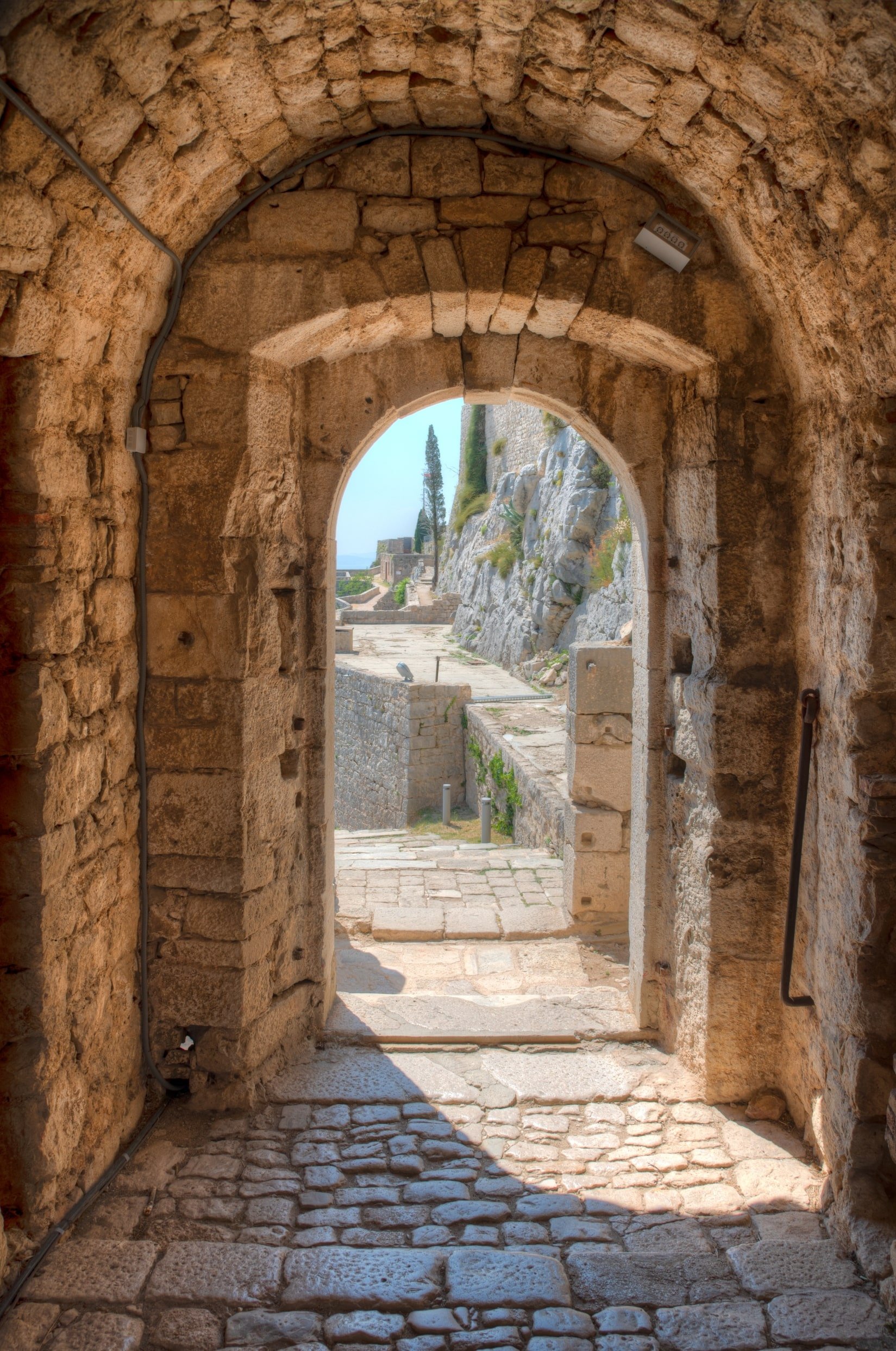
The official Split-Dalmatia tourism board describes Klis as the most beautiful defensive fort in the country, perched between Kozjak and Mosor with a panoramic view over Split and the islands. That part is not tourism-board exaggeration. Klis earns a short visit because the setting does a lot of the work fast.
The official fortress page is also useful on practicals, not just romance. The current ticket includes the Interpretation Centre at Mejdan Square, the fortress itself, Stella Croatica and the Olive Museum. If you are moving efficiently, you do not need to force all of that into one stop, but the interpretation centre is worth knowing about because it gives the fortress more coherence than a pure wall-and-view visit.
The other reason to start here is mental, not logistical. Klis is a strong opener. You understand the geography of inland Split immediately, you get the Uskok and Ottoman frontier layer, and then you go to Salona already seeing the coast as a contested and inhabited landscape rather than just a beach backdrop.
Start at Salona first only if the Roman layer is the actual point
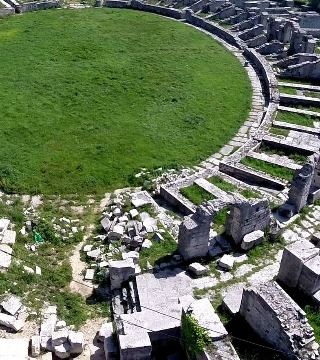
Salona is not a neat single monument. That is exactly why some travelers underrate it and others love it. The official Solin tourism material frames the town as the place where you can still read Roman Dalmatia through the amphitheatre, city gate, Basilica Urbana, Manastirine and the later Croatian royal layer around Hollow Church and Gospin otok. The Archaeological Museum in Split goes deeper and makes clear that Salona was not a decorative ruin field. It was the capital of the Roman province of Dalmatia.
If you care about that scale, Salona deserves concentration. The official Solin page notes that the amphitheatre once held around 15,000 people, while the museum's Salona material shows how much more there is beyond one arena photo, including the city walls, cemeteries and early Christian complexes.
That is why Salona should not be the rushed second stop if Roman archaeology is your real interest. In that case, flip the order or split the visits entirely. Salona gets weaker the moment you treat it like background filler after lunch.

What not to skip at Salona
If you are keeping the trip compact, do not try to absorb every fragment. Focus on the official high-value pieces that keep repeating across the Solin and museum sources: the amphitheatre, the city walls and gates, and Manastirine as one of the major early Christian cemetery complexes under open sky. That gives you the political, urban and religious layers without turning the visit into a blur.
There is also a useful narrative payoff in doing Salona after Klis. Klis shows you how the hinterland controlled the coast. Salona shows you why that coast mattered long before modern Split became the obvious base.
When you should not combine them
Do not combine Klis and Salona in one half day if one of these is true: you love archaeology enough to read sites slowly, you are traveling in high heat and hate exposed walking, or you want to add museums, meals and transport improvisation on the same outing. In those cases, the smarter move is to give Klis its own short visit and let Salona breathe on a separate day.
For everyone else, the pairing is strong precisely because it is not another generic old-town loop. It gives you a vertical view of the region from Klis and a ground-level Roman memory at Salona. That is a better half-day story than trying to pad one site beyond what it naturally offers.